

To rent an apartment you need a packet of about a dozen documents that together answer three questions for the landlord: who you are, whether you can pay, and whether you have paid reliably before. Most applications stall not because the renter doesn't qualify but because one document is missing, stale, or doesn't match the others. The complete 2026 packet — the one that clears screening on the first read — contains:
- A government-issued photo ID (driver's license, passport, or state ID)
- The completed rental application (plus the application/screening fee)
- Proof of income — two to three recent pay stubs, an offer letter, or 1099s and tax returns
- Bank statements (usually the last two to three months)
- Employment verification — an HR contact or an employer letter
- Rental history — previous addresses and landlord references
- Authorization for a credit and background check
- Personal or professional references
- A co-signer or guarantor's ID and income docs (only if your income or credit falls short)
- Supporting documents — SSN or ITIN, pet records, and vehicle information
The exact list varies by landlord, market, and how you earn, but the spine above covers nearly every professionally managed property. The two documents that decide most applications are proof of income and rental history: income shows you can pay, and history shows you will. The income piece leans on the same wage records the federal Fair Labor Standards Act requires employers to keep, and the credit and background checks are governed by the Fair Credit Reporting Act — which is why those documents get the most scrutiny and why a mismatch on them costs you the unit. (For the mechanics of how the income behind them is checked, see how apartments verify income.)
Throughout this guide the worked example is Sofia Reyes, applying for a $1,950/month apartment with a mixed income: $60,000 from a W-2 job and $12,000 from 1099 side work. Her case shows why the document list expands for anyone whose income isn't a single salary — her pay stubs alone don't clear the 3× rent rule, but her complete packet does. If you need to rebuild a missing income document or model your net pay, the MyStubs paystub generator and paycheck calculator handle both.
Paystub Generator
Missing the income document your packet needs?
Changed jobs, paid in cash, or short a pay stub the leasing office requires? The MyStubs paystub generator builds professional, reconciling pay stubs from your real wage totals — the proof-of-income document that decides most applications.
Create a Pay StubWhat Every Application Asks For
Before the renter-type variations, here is the core packet almost every landlord requests, with the purpose of each and the form it usually takes. For the income documents specifically, the rental application income documents checklist goes deeper on what counts toward the rent ratio.
| Document | What it proves | Usual form |
|---|---|---|
| Photo ID | Identity | Driver's license, passport, state ID |
| Rental application | Your stated info & consent | Property's form + fee |
| Proof of income | Ability to pay | 2–3 pay stubs / offer letter / 1099 + returns |
| Bank statements | Income actually lands | Last 2–3 months |
| Employment verification | Job is real & current | HR contact or letter |
| Rental history | Track record | Past addresses + landlord references |
| Credit authorization | Creditworthiness | Signed consent to pull a report |
| References | Character | 2–3 personal/professional |
| Guarantor docs | Backstop if short | Co-signer ID + income (if needed) |
| SSN / ITIN | Screening & tax ID | SSN card or ITIN letter |
Paystub Generator
Create your paystub in minutes
Build a professional paystub with built-in 2026 tax math, all 50 states, and instant PDF download.
Create Your PaystubThe Rental Packet, Document by Document
The proof-of-income document is the one a leasing office reads hardest, so the annotated figure marks what a reviewer checks on it. The same scrutiny is why this document gets its own deep dive among the twelve. Hover or focus any numbered chip for the zone it labels.
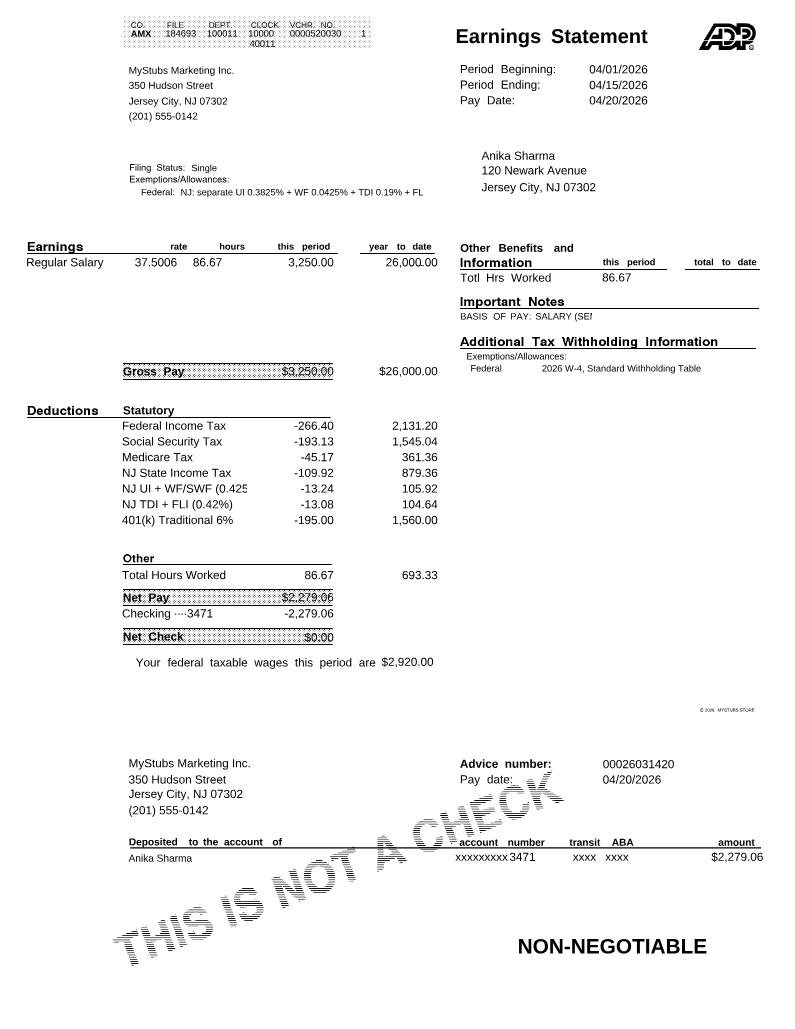
Hover or focus any numbered chip for the zone it labels.
The numbered legend — all twelve documents, why landlords ask, and Sofia's entry:
- Government-issued photo ID. — proves identity and lets the screener match your name across every other document. Acceptable: driver's license, U.S. or foreign passport, state ID, military ID. Sofia: California driver's license.
- Completed rental application. — your stated employment, income, and history, plus signed consent to screen. Most carry an application/screening fee. Sofia: property form, $45 screening fee.
- Proof of income — pay stubs. — two to three recent stubs from a W-2 job, the primary income document; for the full range of accepted proofs, see proof of income for an apartment. Reviewer checks: gross vs. 3× rent, YTD, net vs. deposits. Sofia: three biweekly stubs from her $60,000 job ($5,000/month).
- Proof of income — offer letter. — for a new job with no stub history yet; on letterhead, stating salary and start date. Sofia: not needed (established job), but she includes a recent raise letter.
- Proof of income — 1099s and tax returns. — for self-employed or side income, the 1099-NEC plus last year's Form 1040 with Schedule C; see how to rent when self-employed for the full no-W-2 playbook. Sofia: $12,000 in 1099 income, shown on her return — the income that lifts her over 3×.
- Bank statements. — the last two to three months, proving the income on the stubs and 1099s actually lands. Sofia: statements showing both her biweekly W-2 deposits and her client payments.
- Employment verification. — an HR contact or a signed employer letter confirming role, status, and salary, per the FTC's landlord guidance. Sofia: HR email and phone for the W-2 job.
- Rental history & landlord references. — past addresses and prior-landlord contacts; the strongest predictor of future tenancy. Sofia: two years at her current address, landlord reference attached.
- Credit & background authorization. — signed consent to pull a credit report and background check under the FCRA. You're entitled to free reports at AnnualCreditReport.com. Sofia: consent signed, score 720.
- Personal/professional references. — two or three non-relatives who can speak to reliability. Sofia: a manager and a longtime colleague.
- Co-signer / guarantor documents. — only if your income or credit falls short: the guarantor's ID, income proof, and consent to screen. Sofia: not needed — her full packet clears on its own.
- Supporting documents. — SSN or ITIN, pet records (vaccination, sometimes a pet deposit), and vehicle/parking information. Sofia: ITIN on file, plus cat vaccination records and a pet deposit.
Which Documents You Need by Renter Type
The spine is the same; the proof-of-income column is what changes most. This matrix shows what each renter type leads with.
| Document | W-2 employee | Self-employed / 1099 | New job | First-time renter | Retiree / benefits |
|---|---|---|---|---|---|
| Photo ID | Yes | Yes | Yes | Yes | Yes |
| Pay stubs | 2–3 | n/a | First + offer | 2–3 | n/a |
| Offer letter | If new | n/a | Required | If new grad | n/a |
| Tax returns / 1099 | Optional | Required (2 yrs) | Optional | n/a | Optional |
| Bank statements | Corroborates | Primary | Corroborates | Corroborates | Primary |
| Benefit/award letter | n/a | n/a | n/a | n/a | Required (SSA/pension) |
| Rental history | Yes | Yes | Yes | Substitute w/ references | Yes |
| Guarantor | If short | If variable | Often | Often | Rarely |
Document Recency and Count
Recency is a hard filter — a leasing office will reject a stale document even when the underlying facts are fine.
| Document | How many | How recent |
|---|---|---|
| Pay stubs | 2–3 (4–6 if hourly) | Within 30–60 days |
| Bank statements | 2–3 months | Most recent closed statements |
| Tax returns | Last 1–2 years | Most recent filed |
| Offer letter | 1 | Dated, current role |
| Photo ID | 1 | Unexpired |
| Landlord reference | 1–2 | Current + prior tenancy |
| Credit authorization | 1 | Signed at application |
Why Sofia Needs More Than Pay Stubs
Sofia's case is the reason the document list expands for mixed income. Her W-2 stubs alone fall short of the 3× rule; the full packet clears it.
| Step | Math | Result |
|---|---|---|
| W-2 monthly gross | $60,000 ÷ 12 | $5,000.00 |
| 3× requirement for $1,950 rent | $1,950 × 3 | $5,850.00 needed |
| W-2 income alone | $5,000 ÷ $1,950 | 2.56× — short |
| Add 1099 monthly income | $12,000 ÷ 12 | +$1,000.00 |
| Total monthly gross | $5,000 + $1,000 | $6,000.00 |
| Combined income ratio | $6,000 ÷ $1,950 | 3.08× ✓ |
| Documents that prove the extra $1,000 | 1099 + Schedule C + bank deposits | required |
Without the 1099, the Schedule C on her Form 1040, and the bank statements showing the client payments land, Sofia's application reads as a 2.56× file and likely gets denied. With them, it reads as 3.08× and clears. The documents aren't bureaucratic box-checking — they are literally what moves her from "short" to "qualified."
What Counts as Each Document
A document only works if it's the right form. The most common rejections come from submitting something adjacent to what was asked.
| For… | Usually accepted | Usually not accepted |
|---|---|---|
| Proof of income | Pay stubs, offer letter, 1099 + return, benefit letter | A screenshot of a banking app balance |
| Identity | Unexpired ID with photo | Expired ID, photocopy of a photocopy |
| Income lands | Official PDF/printed bank statements | Edited or partial statements |
| Self-employment | Tax return + 1099 + bank deposits | A personal spreadsheet alone |
| Rental history | Prior-landlord contact, lease copies | "I lived with family" with no reference |
| New job | Letterhead offer with salary & start date | A verbal offer or a text message |
Document Mistakes That Sink an Application
These are packet errors, not income problems — every one is avoidable:
- A name mismatch across the ID, application, and pay stub (a nickname vs. your legal name)
- Stale documents — stubs or statements older than 60 days
- Proof of income that falls short of 3× because side or benefit income wasn't documented (Sofia's exact trap)
- A banking-app screenshot instead of an official statement
- Editing or redacting a document so heavily it looks altered
- No rental history and no substitute — first-time renters who bring neither references nor a guarantor
- Forgetting the application fee, which stalls the whole file before screening starts
- An offer letter without a salary or start date, so it proves nothing quantifiable
- No co-signer when income or credit is genuinely short, instead of lining one up early
- Submitting documents piecemeal, forcing the reviewer to chase the missing pieces
The fix is to assemble the complete packet before you apply and attach a cover sheet listing what's enclosed. If a genuine income document is missing — a job change left a payroll gap, or cash work needs to be put on paper — rebuild the real figures into a clean stub rather than submitting nothing. The MyStubs paystub generator documents real income; it does not invent it.
Attach this on top of your packet so the reviewer sees a complete, organized file at a glance. Copy, paste, and fill the brackets.
| Document check | Sofia's packet passes when |
|---|---|
| Photo ID, unexpired, name matches everything | California license, "Sofia Reyes" on all docs |
| Application complete + fee paid | Property form, $45 screening fee paid |
| 2–3 recent pay stubs (W-2 job) | Three biweekly stubs, $5,000/month |
| Side/1099 income documented | $12,000 1099 + Schedule C attached |
| Combined income ≥ 3× rent | $6,000 ≥ $5,850 needed (3.08×) ✓ |
| Bank statements show deposits land | W-2 and client deposits both visible |
| Employment verification included | HR contact for the W-2 job |
| Rental history + landlord reference | Two years current address, reference attached |
| Credit/background authorization signed | Signed, score 720 |
| References listed | Manager + colleague |
| Guarantor lined up if income/credit short | Not needed — packet clears alone |
| Supporting docs attached | ITIN, cat records, pet deposit, vehicle |
Application Fees, Deposits, and Screening Rules
The documents come with money and with rights. Application fees, security deposits, and screening rules vary widely by state and city, so confirm the local cap before you pay.
| Item | What to expect | Source / note |
|---|---|---|
| Application/screening fee | Often $25–$75; many states cap it | CA Civ. Code §1950.6 (example cap) |
| Security deposit | Commonly 1–2 months; capped in many states | CA Civ. Code §1950.5 (example cap) |
| Credit report access | Free annual reports | AnnualCreditReport.com |
| Denial from a screening report | Adverse-action notice naming the company | CFPB |
| Source-of-income rejection | May be barred (varies by state/city) | HUD Fair Housing |
| Protected-class treatment | Prohibited nationwide | Fair Housing Act / HUD |
Two rights are worth knowing before you hand over documents. First, if a screening report drives a denial, the FCRA entitles you to an adverse-action notice and a free copy of that report, so you can correct an error before applying elsewhere. Second, a growing number of states and cities prohibit rejecting an applicant solely because their income comes from a voucher, Social Security, or disability — but coverage is uneven, so check your jurisdiction. Keep copies of everything you submit, and never hand over original documents you can't replace.
What documents do I need to rent an apartment?
At minimum: a government-issued photo ID, a completed rental application with the screening fee, proof of income (two to three recent pay stubs, or 1099s and tax returns if self-employed), bank statements, employment verification, rental history with landlord references, and signed consent for a credit and background check. Many landlords also ask for personal references and, if your income or credit is short, a guarantor. The two documents that decide most applications are proof of income and rental history. Assemble the full packet before you apply and attach a cover sheet listing everything enclosed so the reviewer sees a complete file at a glance.
Do I need a credit check to rent an apartment?
Almost always, yes — most landlords and screening platforms run a credit and background check, and your application includes signed consent for it. The check is governed by the Fair Credit Reporting Act, which means if a report leads to a denial, the landlord must give you an adverse-action notice naming the screening company, and you can get a free copy to review and dispute. You're also entitled to free annual credit reports at AnnualCreditReport.com, so check yours before you apply. Thin or no credit isn't automatically disqualifying — strong income, solid rental history, or a guarantor can offset it.
What if I have no rental history as a first-time renter?
Substitute other evidence of reliability. Strong proof of income (stubs or an offer letter), a good credit score, personal or professional references, and proof of savings all help. A guarantor or co-signer — often a parent — is the most common solution for first-time renters, especially recent graduates. Some landlords accept a larger security deposit or a few months prepaid where state law allows. Offering to set up automatic rent payments can also reassure a landlord. The goal is to replace the missing track record with enough other signals that the landlord can predict you'll pay reliably.
Can I rent an apartment without a Social Security number?
Often, yes. Many landlords accept an Individual Taxpayer Identification Number (ITIN) in place of an SSN, along with a passport or other government ID. Without either, you can strengthen the application with proof of income, bank statements, references, a larger deposit, or a guarantor. International applicants and newcomers commonly rent successfully by leading with income documentation and references rather than a domestic credit history. Policies vary by landlord, so ask up front what identification they accept; a property that screens primarily on income and references is usually the more flexible option.
How recent do my rental documents need to be?
Recency is a hard filter. Pay stubs should generally be from the last 30–60 days; bank statements should be your most recent closed statements (typically the last two to three months); your ID must be unexpired; and your tax return should be the most recently filed year. An offer letter should be current and reflect your present role. A leasing office will often reject a stale document even when the underlying facts haven't changed, so refresh anything older than about 60 days before you submit. If you're applying to several units, regenerate the dated documents rather than reusing a months-old packet.
What documents do self-employed renters need?
Self-employed and 1099 renters lead with tax documents instead of pay stubs: typically the last one to two years' tax returns with Schedule C, your 1099-NEC forms, and two to three months of bank statements showing client payments land. A profit-and-loss statement, a CPA letter, and current-year invoices strengthen the file further. Because there's no employer stub, bank statements often become the primary proof that income is real and recurring. The 3× rule runs on your net self-employment income, so document enough history to show the figure is stable. A guarantor helps if your income is variable or your history is short.
What is a guarantor and when do I need one?
A guarantor (or co-signer) is someone who legally agrees to pay your rent if you can't — usually a parent or close relative with strong income and credit. You typically need one when your income falls short of the 3× rule, your credit is thin or low, you're a first-time renter with no history, or you're a student. The guarantor submits their own packet: photo ID, proof of income (often at a higher multiple, like 5× rent), and consent to a credit check. Line one up early rather than scrambling after a denial — a ready guarantor packet can turn a borderline application into an approval.
How much are application fees and security deposits?
Application or screening fees commonly run $25–$75 per applicant, and many states cap the amount and require a receipt or refund of the unused portion. Security deposits are commonly one to two months' rent, and a large number of states cap them — California, for example, limits deposits by statute. You may also face first and last month's rent up front. These amounts vary widely by state and city, so confirm the local limits before you pay, and get every payment in writing. If a deposit or fee seems above the legal cap for your area, that's worth questioning before you sign. — Lena Brooks, Rental & Tenant-Screening writer at MyStubs. Lena covers rental applications, income verification, and the FCRA rules that govern tenant screening, with a focus on the documents leasing offices and screening platforms actually require before they approve a file.
Official sources
Sources · 13 references
- U.S. Department of Labor — FLSA Recordkeeping Fact Sheet 21
- Federal Trade Commission — Tenant Background Checks
- Federal Trade Commission — Using Consumer Reports: What Landlords Need to Know
- Federal Trade Commission — Fair Credit Reporting Act (full text)
- Consumer Financial Protection Bureau — Notice of Adverse Action
- U.S. Department of Housing and Urban Development — Fair Housing Act Overview
- Internal Revenue Service — About Form W-2
- Internal Revenue Service — About Form 1099-NEC
- Internal Revenue Service — About Schedule C (Form 1040)
- Internal Revenue Service — Individual Taxpayer Identification Number (ITIN)
- AnnualCreditReport.com — Free Federal Credit Reports
- California Legislature — Civil Code §1950.5, Security Deposits
- California Legislature — Civil Code §1950.6, Application Screening Fee


Discussion
No comments yet — be the first to share a state-specific note, a follow-up question, or a correction.