

A recent pay stub is the single strongest proof of income for an apartment, but a leasing office almost never accepts one stub alone. The packet that clears screening fastest pairs two or three consecutive stubs with the documents that corroborate them, and it is built so a reviewer can run the 3× rent rule in under a minute. A pass-on-the-first-read income packet carries:
- Two to three of your most recent consecutive pay stubs (dated within the last 30–60 days)
- Gross monthly income of at least 3× the rent — the number the screening rule runs on
- Year-to-date (YTD) gross that annualizes to the salary you claim
- Net pay that matches the direct deposits on your bank statement
- Tax withholding lines present (federal, Social Security, Medicare) — proof of real W-2 employment
- An employer name, address, and phone the office can call to verify
- Your legal name exactly as it appears on your photo ID and application
- A short cover note that does the 3× math for the reviewer
A pay stub works as proof of income because it shows, on one page, who pays you, how much, how often, and how much actually lands in your bank account — the four facts a landlord needs to predict whether rent will be paid. The underlying wage data the stub prints is the same data the federal Fair Labor Standards Act requires every employer to keep, which is why a real stub is hard to fake convincingly and why screening platforms lean on it. The catch is that landlords read the stub holistically and run a reconciliation: gross supports the rent, YTD supports the gross, net supports the bank statement. If any of the three legs is missing or does not tie out, the application slows down or gets denied — regardless of how high the headline salary looks.
If you want to model your own gross-to-net before you read your real stub — or sanity-check that your net pay should match your deposits — the MyStubs paycheck calculator reproduces the period math for your state.
Paystub Generator
Rebuild a missing or mid-year pay stub for your application
Changed jobs, paid in cash, or missing a stub the leasing office needs? The MyStubs paystub generator renders professional, reconciling pay stubs from your real wage totals — gross, taxes, YTD, and net — in the layout a leasing office reads first.
Create a Pay StubHow Much Income Your Stub Has to Show
Most landlords and screening platforms apply an income-to-rent ratio. The most common is the 3× rule: gross (pre-tax) monthly income must be at least three times the monthly rent. Some markets run 2.5×, some luxury buildings run 40× monthly rent stated as an annual figure (40 × rent = required annual salary, the same as the 3× monthly test), and many use the renter-side mirror of the rule — keep rent at or under 30% of gross income. The ratio is a convention, not a law, so it varies by landlord, city, and unit; the safe move is to assume 3× gross and document above it.
| Monthly rent | 3× gross/month needed | Equivalent annual salary |
|---|---|---|
| $1,200 | $3,600 | $43,200 |
| $1,500 | $4,500 | $54,000 |
| $1,800 | $5,400 | $64,800 |
| $2,100 | $6,300 | $75,600 |
| $2,500 | $7,500 | $90,000 |
| $3,000 | $9,000 | $108,000 |
The most common self-inflicted denial is running the ratio on net pay instead of gross. The rule is built on gross income; if you compare your take-home to 3× rent you will undercount yourself and may not apply for a unit you actually qualify for. Throughout this guide the worked example is Dana Crawford, applying for an $1,800/month apartment in Austin, Texas, on a $66,000 salary paid biweekly — a file that clears 3× by a thin margin ($5,500 vs. $5,400 needed), which is exactly the case where stub quality decides the outcome.
Paystub Generator
Create your paystub in minutes
Build a professional paystub with built-in 2026 tax math, all 50 states, and instant PDF download.
Create Your PaystubWhat a Landlord Reads on Your Pay Stub, Line by Line
A leasing reviewer does not read a stub top to bottom — they jump to eight zones, in roughly this order, and reconcile them against each other and against your other documents (for the full screening workflow, see how apartments verify income). The annotated figure below is a real biweekly stub marked with the zones a reviewer checks. Hover or focus any numbered chip for the zone it labels.
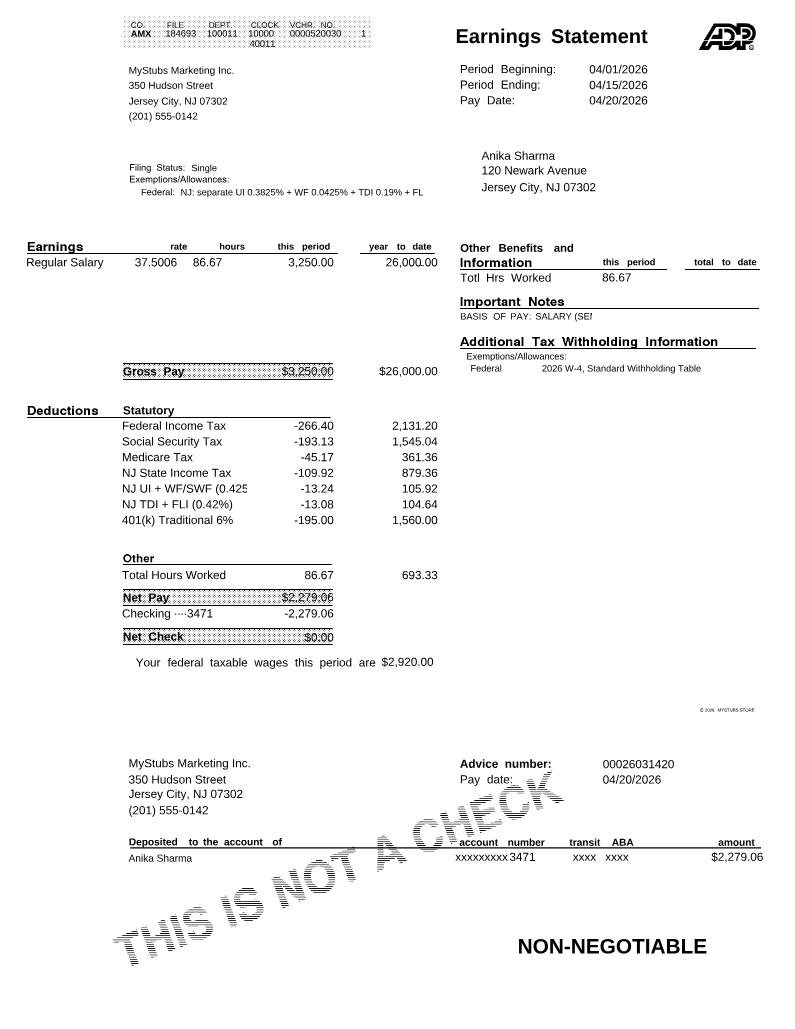
Hover or focus any numbered chip for the zone it labels.
The numbered legend, mirrored from the chips, with what each zone proves and Dana's entry:
- Employer block. — legal name, address, and a phone number. Proves the employer exists and can be reached for verification. Dana: Lone Star Web Studio LLC, 900 Congress Ave, Austin, TX, with an HR line.
- Employee name. — must match your government photo ID and your application exactly. A nickname here ("Dan" vs. "Dana," "Danny C." vs. "Dana Crawford") reads as a mismatch. Dana: Dana Crawford, matching her Texas driver's license.
- Pay date and pay-period dates. — recency is a hard filter; most offices want stubs from the last 30–60 days. Dana: latest stub dated 18 days before she applied.
- Gross pay. — the pre-tax figure the 3× rule runs on. Dana: $2,538.46 per biweekly period → $5,500.00/month ($66,000 ÷ 12).
- Hours worked. — for hourly applicants, hours confirm the role is full-time; a stub showing 25 hours/week annualizes to far less than the salary an applicant claims. Dana is salaried-exempt, so hours are implied.
- Taxes withheld. — federal income tax, Social Security at 6.2%, and Medicare at 1.45% per the SSA wage base. Their presence signals genuine W-2 employment; a stub claiming W-2 work with zero withholding is a classic fabrication tell. Dana: $416.57/period.
- Year-to-date gross. — annualizes the income and shows employment continuity. Dana at period 10: $25,384.62, which annualizes to $66,000 (× 26 ÷ 10).
- Net pay. — the deposit-settled figure a reviewer matches against your bank statement. Dana: $2,121.89/period, matching the recurring direct deposit on her enclosed statements.
The reconciliation across zones 4, 7, and 8 is the whole game: gross supports the rent (zone 4 vs. 3× rule), YTD supports the gross (zone 7 ÷ periods × frequency = annual), and net supports the bank (zone 8 = the deposit). A stub that nails all three reads as authentic in seconds.
Recency and Count by Situation
How many pay stubs you need depends on how you are paid and how long you have been there. The default ask is two to three consecutive stubs; the exceptions are below.
| Your situation | Typical ask | Why |
|---|---|---|
| Standard salaried W-2 | 2–3 most recent consecutive stubs | Shows a stable, repeating amount |
| Hourly / variable hours | 4–6 stubs or a full 3 months | Averages out week-to-week swings |
| Brand-new job | Offer letter + first stub(s) | History not built yet; the letter carries it |
| Just relocated / first job | Offer letter + employer verification | No prior stubs exist |
| Bonus or commission earner | 3–6 months + last year's W-2 | Smooths irregular pay into a run-rate |
| Self-employed / 1099 | 2 years' tax returns + 1099s + bank statements | No employer stub is issued |
| Two or more jobs | 2–3 stubs from each employer | Combined income clears the ratio |
Run the 3× Check on Dana's Stub
The verification a renter (or a reviewer) runs is three quick calculations, all off the stub plus one bank statement. Here it is on Dana's file.
| Step | Math | Result |
|---|---|---|
| Monthly gross income | $66,000 ÷ 12 | $5,500.00 |
| Landlord 3× requirement | $1,800 × 3 | $5,400.00 needed |
| Income-to-rent ratio | $5,500 ÷ $1,800 | 3.06× ✓ |
| Rent-to-income (renter mirror) | $1,800 ÷ $5,500 | 32.7% |
| YTD annualization (period 10) | $25,384.62 ÷ 10 × 26 | $66,000 ✓ |
| Net per period | $2,538.46 − $416.57 taxes | $2,121.89 |
| Deposit match | bank statement shows | $2,121.89 biweekly ✓ |
Dana clears 3× by $100/month — a thin margin. That is precisely why her packet leads with the YTD annualization and the net-to-deposit match: a reviewer staring at a borderline ratio approves faster when the supporting math is airtight. The taxes line (federal income tax via the IRS Publication 15-T percentage method, Social Security, and Medicare) is what confirms she is a real W-2 employee rather than someone who printed a number on a page.
How the Stub Proof Changes by How You're Paid
The eight zones stay the same; what shifts is which zone carries the weight and what you must add alongside the stub. A pay stub is the strongest single document, but it is one of several proof-of-income documents landlords accept; if you do not have W-2 stubs at all, see how to rent when self-employed.
| Stub check | Salaried-exempt | Hourly non-exempt | New job | Gig / 1099 | Multiple jobs |
|---|---|---|---|---|---|
| Gross basis for 3× | Salary ÷ 12 | Rate × hours × frequency | Offer-letter salary | Net Schedule C ÷ 12 | Sum of all jobs |
| Hours needed on stub | Implied | Required (prove full-time) | n/a yet | n/a | Per job |
| Recency expected | 2–3 stubs | 3 months | First stub + letter | 2 yrs returns | Each employer |
| YTD relevance | Confirms salary | Confirms run-rate | Not built yet | From tax return | Per stub |
| Must add alongside | Offer/HR letter | More stubs | Offer letter | 1099 + bank + returns | Stubs from each |
| Common shortfall risk | Low | Variable hours | No history | Variable income | Coordination |
Mistakes That Get a Rental Application Denied
The denials below come from the stub or the packet, not from the income itself — they are avoidable:
- Running the 3× rule on net pay instead of gross, undercounting yourself out of a unit you qualify for
- Submitting one stub when the office wants two or three consecutive ones
- A stub older than 60 days — recency is a hard filter at most properties
- A nickname on the stub vs. the legal name on your ID and application
- Zero tax withholding on a stub that claims W-2 employment (reads as a contractor stub or a fabrication)
- A YTD figure that won't annualize to the salary claimed, with no note explaining a mid-year start
- Bank deposits that don't match net pay (paid into a different account, partly in cash, or fabricated)
- Forgetting the second job whose income you need to clear the 3× bar
- A one-time bonus inflating a single stub, making the income look higher than the run-rate
- Hours on an hourly stub that imply part-time, so the annualized figure falls short of 3×
The fix for almost all of these is the same: send the corrected or complete packet before the reviewer has to ask. If a stub is genuinely missing — a job change, a payroll gap, a cash-paid stretch you have since documented — rebuild the real figures into a clean stub rather than submitting nothing. The MyStubs paystub generator renders the eight-zone layout above from your actual wage totals; it documents real income, it does not invent it.
Copy, paste, and fill the bracketed fields. Attach it on top of your stubs so the reviewer can run the 3× math without doing arithmetic.
| Check | Dana's packet passes when |
|---|---|
| Employer legal name matches the application | "Lone Star Web Studio LLC" matches both |
| Employee name matches the photo ID exactly | "Dana Crawford" = Texas driver's license |
| Most recent stub is within 30–60 days | Latest dated 18 days before applying |
| Pay frequency is stated | "Biweekly (period 10 of 26)" printed |
| Gross monthly income ≥ 3× rent | $5,500 ≥ $5,400 needed ✓ |
| YTD gross annualizes to the stated salary | $25,384.62 → $66,000 |
| Net pay matches the bank deposit | $2,121.89 = recurring direct deposit |
| Tax withholding lines all present | Federal, Social Security, Medicare shown |
| No undisclosed garnishment or large deduction | None on the stub |
| 2–3 consecutive stubs are internally consistent | Three identical biweekly stubs |
| A cover note does the 3× math for the reviewer | Attached, ratio stated as 3.06× |
Screening, Denials, and Source-of-Income Rules
A tenant-screening report is a consumer report, so the Fair Credit Reporting Act applies when a landlord uses one to make a decision. That gives applicants concrete rights — and gives landlords concrete obligations.
| If the landlord… | Your right / their obligation | Source |
|---|---|---|
| Denies you based on a screening report | They must give an adverse-action notice naming the screening company | FCRA / FTC |
| Uses a tenant-screening report | You can request a free copy from that company | FTC tenant background checks |
| Pulls your credit | You're entitled to free reports at AnnualCreditReport.com | FCRA |
| Charges an application/screening fee | Many states cap the fee and require a receipt | State law (e.g., CA Civ. Code §1950.6) |
| Rejects a lawful income source (voucher, SSDI, child support) | Source-of-income laws may bar this | HUD Fair Housing + state/local law |
| Treats you differently by a protected class | The Fair Housing Act prohibits it | HUD |
Source-of-income protection is the one most renters miss: a growing list of states and cities bar landlords from refusing tenants because their income comes from a housing voucher, Social Security, disability, or other lawful non-wage sources — but coverage is uneven, so check your state and city before assuming you are protected. If you are denied, the adverse-action notice is your lever: it names the screening company, and you can request the report, check it for errors, and dispute anything inaccurate before you apply elsewhere.
How many pay stubs do I need to rent an apartment?
Most leasing offices ask for two to three consecutive pay stubs from the last 30–60 days. Salaried W-2 employees can usually stop at two or three because the amount repeats; hourly or variable-hours workers are often asked for a full three months (four to six stubs) so the reviewer can average out week-to-week swings. If you have been at the job only a few weeks, pair your first stub with the offer letter. The goal is to show a stable, repeating amount that annualizes to the income you claim on the application.
Can I use a pay stub if I just started a new job?
Yes, but pair it with your offer letter . A first stub proves the job is real and shows the rate; the offer letter (on company letterhead, stating salary and start date) carries the annual income the stub cannot yet demonstrate through year-to-date totals. Many leasing offices accept an offer letter plus the first one or two stubs, sometimes with an employment-verification call to HR. If you have not received any stub yet, the offer letter plus a verification contact is the standard substitute until your first payday.
Do landlords actually verify pay stubs with employers?
Often, yes. Larger properties and professional screening platforms call the employer's HR line or use a verification service, and many run the stub's net pay against your bank statements to confirm the deposits land. That is why the employer block on the stub needs a working phone number and why your name must match your ID exactly. Make verification easy: list an HR contact in your cover note. A stub that cannot be verified — unreachable employer, mismatched name, no tax withholding — is the one most likely to stall an otherwise strong application.
What if my income is below 3× the rent?
You have several real options. Add a co-signer or guarantor whose income clears the bar; document additional income (a second job, 1099 work, benefits, or regular bank deposits) that the reviewer can count; offer a larger security deposit or a few months prepaid where state law allows; or apply with a roommate so combined income qualifies. Some landlords accept 2.5× or weigh strong credit and rental history against a slightly low ratio. Lead with the documentation: a borderline ratio backed by clean stubs and a guarantor often beats a higher claimed income with a thin file.
Can I use a pay stub instead of a bank statement?
They do different jobs, and strong packets include both. A pay stub proves your wage run-rate — gross, frequency, taxes, and net. A bank statement proves the money actually lands in your account, which is how a reviewer confirms the stub's net pay is real. For a W-2 employee, the stub is the primary document and the statement corroborates it. For self-employed or cash-paid applicants, bank statements often become the primary proof because no employer stub exists. Submitting both, with net pay matching the deposits, is what makes a file read as authentic.
What income counts toward the 3× rule?
Generally, stable, documentable, recurring income counts: W-2 wages, salary, regular overtime, 1099/self-employment net income, Social Security and disability benefits, pension and retirement income, child support or alimony received under a court order, and sometimes housing vouchers. One-time bonuses, irregular gig spikes, and undocumented cash usually do not count toward the ratio unless you can show a consistent history. The reviewer wants income they can predict will continue through the lease term — so the more consistently a source shows up across your stubs, tax returns, and bank statements, the more weight it carries.
Can a landlord legally reject my pay stub or application?
A landlord can reject an application for income, credit, or rental-history reasons, but not for a protected-class reason under the Fair Housing Act , and in a growing number of states and cities, not because of a lawful source of income like a voucher or disability benefit. If a screening report drives the denial, the FCRA requires an adverse-action notice naming the screening company, and you can get a free copy of that report and dispute any errors. A rejection for a genuinely low ratio or a discrepancy on the stub is generally allowed; a rejection that tracks a protected class is not.
Is a single pay stub ever enough on its own?
Rarely. A lone stub shows one period but not consistency, and it cannot demonstrate the year-to-date continuity reviewers look for. The cases where one stub may suffice are a brand-new job paired with an offer letter, or a low-friction private landlord who also takes a verification call. For anything competitive — a professionally managed building, a tight rental market, a borderline 3× ratio — assume you need two to three consecutive stubs plus corroborating documents. When in doubt, send more proof than asked; an over-documented file clears screening faster than an under-documented one. — Lena Brooks, Rental & Tenant-Screening writer at MyStubs. Lena covers rental applications, income verification, and the FCRA rules that govern tenant screening, with a focus on what leasing offices and screening platforms actually check before they approve a file.
Official sources
Sources · 11 references
- U.S. Department of Labor — FLSA Recordkeeping Fact Sheet 21
- Federal Trade Commission — Tenant Background Checks
- Federal Trade Commission — Using Consumer Reports: What Landlords Need to Know
- Federal Trade Commission — Fair Credit Reporting Act (full text)
- Consumer Financial Protection Bureau — Notice of Adverse Action
- U.S. Department of Housing and Urban Development — Fair Housing Act Overview
- AnnualCreditReport.com — Free Federal Credit Reports
- Internal Revenue Service — About Form W-2
- Internal Revenue Service — Publication 15-T, Federal Income Tax Withholding Methods
- Social Security Administration — 2026 Contribution and Benefit Base
- California Legislature — Civil Code §1950.6, Application Screening Fee


Discussion
No comments yet — be the first to share a state-specific note, a follow-up question, or a correction.